Sacramento's urban forest took a big hit from storms
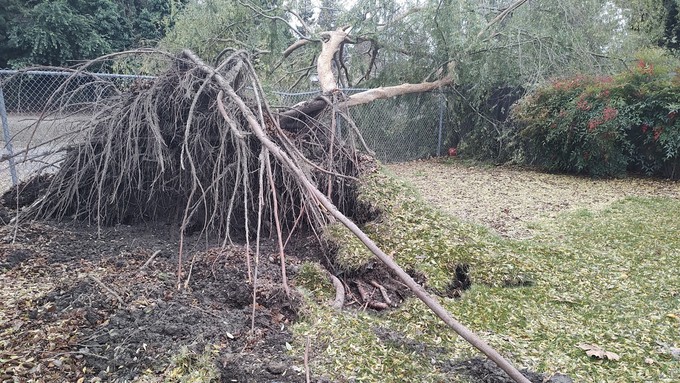
This elm in the Pocket was one of the early victims of the current series of storms. Debbie Arrington
Besides dumping an amazing amount of rain, these ferocious winter storms have packed a wallop to Sacramento’s famous urban forest. By reported estimates, the City of Trees lost nearly 1,000 trees since New Year’s Eve – and that’s not counting what came down in the wee hours of Tuesday morning.
The City of Sacramento reports that it received about 700 requests for downed tree removal in the first six days of January. Many more requests have come in since.
Removal is a slow process. In that first week, city crews were able to deal with about 200 of the downed trees. Part of the problem? Not enough cranes. Fallen giants weigh tons.
One particularly large victim: The giant sequoia at Capitol Park. About a century old, the mammoth redwood went over and took most of a neighboring Torrey pine with it.
Some Sacramento County and city parks lost dozens of trees. In Yolo County, the UC Davis Arboretum lost at least 15 otherwise healthy trees including a Guadalupe Island cypress planted in 1936.
A combination of saturated soil and extreme wind gusts – some over 60 mph – brought down these big trees, many of which had roots weakened by years of drought.
Through Jan. 9, downtown Sacramento has received 4.48 inches of rain this month. That was on top of 9.52 inches in December including a record 2.37 on New Year’s Eve. That’s nearly 7 inches in 10 days – almost as much rain as Sacramento received in all of 2020. Before December’s deluge, Sacramento’s rain total for the first 11 months of 2022 was 4.31 inches.
So much rain has saturated our slow-draining clay soils. Trees are literally standing in slippery mud, and they’re losing their grips on their soggy toeholds. At some point, those roots start to give way. Called soil separation, this process can form cracks on the surface – like little earthquake faults running through the lawn. It’s one of the few warning signs before a tree goes down.
Cypress, elms and redwoods are among the most common victims of these January storms but so are many other species, especially those with leaves or needles. Foliage on evergreen trees can create a giant sail to catch wind gusts, strong enough to push it over or rip off branches.
Drought’s long-term effects can be seen in the roots of fallen trees. Healthy tree roots grow deep and stretch out as far as the tree’s canopy – the outer reach of its limbs. But often, these toppled giants reveal rootballs that are barely wider than their trunks. Such was the case in Midtown, where fallen 60-foot trees had rootballs no wider than their space between the street and sidewalk. Roots had died back so much, they were no longer strong enough to hold the tree upright.
The solution: Keep trees as healthy as possible before storms hit. That includes deep, infrequent irrigation to encourage strong roots.
In the meantime, watch out for those soil cracks around trunks and be ready for more falling branches. According to the National Weather Service, more rain and wind is in the Sacramento forecast at least through Monday.
For more on tree care and how to hire an arborist: www.sactree.org.
Comments
0 comments have been posted.Sacramento Digs Gardening to your inbox.
Flowers in My Back Yard Series
March 10: Keep camellias happy for years to come
March 3: Fruit tree blossoms are a fleeting joy
Feb. 27: Are your roses looking rusty?
Feb. 24: Treasure spring daffodils now and for years to come
Feb. 17: How and why to grow wildflowers
Feb. 10: Let's talk Valentine's Day roses
Feb. 3: Why grow flowers?
Local News

Sites We Like
Garden checklist for week of March 15
Enjoy these sunny days and show your garden some TLC. Don’t forget to water.
* Weed, weed, weed! Get them before they flower. Take a hoe and whack them at the base.
* Prepare vegetable beds for summer favorites. Spade in compost and other amendments.
* In the vegetable garden, transplant lettuce. Last chance this spring to transplant cole family plants such as broccoli, collards and kale.
* Seed chard and beets directly into the ground. Soak beet seeds before planting to aid germination.
* Harvest fall-planted lettuce and cabbage before it “bolts” – sending out flower shoots.
* Fertilize roses, annual flowers and berries as spring growth begins to appear.
* Prune and fertilize spring-flowering shrubs after bloom.
* Feed camellias at the end of their bloom cycle. Pick up browned and fallen flowers to help corral blossom blight.
* Feed citrus trees, which are now in bloom and setting fruit. To prevent sunburn and borer problems on young trees, paint the exposed portion of the trunk with diluted white latex (water-based) interior paint. Dilute the paint with an equal amount of cold water before application.
* Feed roses with a balanced fertilizer (such as 10-10-10 or 4-4-4, the ratio of nitrogen, phosphorus and potassium available in that product).
* Prune and fertilize spring-flowering shrubs and trees after they bloom. Try using well-composted manure, spread 1-inch-thick under the tree. This serves as both fertilizer and mulch, retaining moisture while cutting down on weeds.
* Cut back and fertilize perennial herbs to encourage new growth.
* Plant summer bulbs, including gladiolus, tuberous begonias and callas. Also plant dahlia tubers.
* Shop for perennials. Many varieties are available in local nurseries and at plant events. They can be transplanted now while the weather remains relatively cool.
* Seed and renovate the lawn, if you have one. Feed cool-season grasses such as bent, blue, rye and fescue with a slow-release fertilizer. Check the irrigation system and perform maintenance. Make sure sprinkler heads are turned toward the lawn, not the sidewalk.
Contact Us
Send us a gardening question, a post suggestion or information about an upcoming event. sacdigsgardening@gmail.com
Food in My Back Yard (FIMBY) Series
Lessons learned during a year of edible gardening
WINTER
Is edible gardening possible indoors?
Hints for choosing tomato seeds
Why winter is the perfect time to plant fruit trees
When to plant? Consider staggering your transplants
How to squeeze more food into less space
Plant a fruit tree now -- for later
Win the weed war by tackling them in winter
Tips for planting bare-root trees, shrubs and vegetables
Time to give vegetable seedlings some more space
Ways to win the fight against weeds
FALL
Dec. 16: Add asparagus to your edible garden
Dec. 9: Soggy soil and what to do about it
Dec. 2: Plant artichokes now; enjoy for years to come
Nov. 25: It's late November, and your peach tree needs spraying
Nov. 18: What to do with all those fallen leaves?
Nov. 11: Prepare now for colder weather in the edible garden
Nov. 4: Plant a pea patch for you and your garden
Oct. 27: As citrus season begins, advice for backyard growers
Oct. 20: Change is in the autumn air
Oct. 13: We don't talk (enough) about beets
Oct. 6: Fava beans do double duty
Sept. 30: Seeds or transplants for cool-season veggies?
Sept. 23: How to prolong the fall tomato harvest
SUMMER
Sept. 16: Time to shut it down?
Sept. 9: How to get the most out of your pumpkin patch
Sept. 2: Summer-to-fall transition time for evaluation, planning
Aug. 26: To pick or not to pick those tomatoes?
Aug. 19: Put worms to work for you
Aug. 12: Grow food while saving water
Aug. 5: Enhance your food with edible flowers
July 29: Why won't my tomatoes turn red?
July 22: A squash plant has mosaic virus, and it's not pretty
July 15: Does this plant need water?
July 8: Tear out that sad plant or baby it? Midsummer decisions
July 1: How to grow summer salad greens
June 24: Weird stuff that's perfectly normal
SPRING
June 17: Help pollinators help your garden
June 10: Battling early-season tomato pests
June 3: Make your own compost
May 27: Where are the bees when you need them?
May 20: How to help tomatoes thrive on hot days
May 13: Your plants can tell you more than any calendar can
May 6: Maintain soil moisture with mulch for garden success
April 29: What's (already) wrong with my tomato plants?
April 22: Should you stock up on fertilizer? (Yes!)
April 15: Grow culinary herbs in containers
April 8: When to plant summer vegetables
April 1: Don't be fooled by these garden myths
March 25: Fertilizer tips: How to 'feed' your vegetables for healthy growth

 Powered by California Local